PPSC Exam Preparation in 3 Months: Complete Study Plan
PPSC Exam Preparation in 3 Months: Complete Study Plan
Introduction
Let me be direct with you: most PPSC aspirants fail not because they lack intelligence they fail because they lack a system.
I’ve seen this pattern repeat itself thousands of times in competitive exam preparation. Students spend months reading random books, watching YouTube videos without direction, and then walk into the exam hall underprepared. The result? Another failed attempt, another year of waiting.
But here’s the good news: PPSC exam preparation in 3 months is absolutely achievable if you follow the right strategy from day one.
In this guide, I’ll walk you through a complete, month-by-month PPSC preparation plan built on proven study principles. Whether you’re a fresh graduate or a working professional attempting the PPSC test for the first time, this roadmap will give you everything you need to compete seriously.
Let’s get into it.
What is the PPSC Exam and Who is it For?
The Punjab Public Service Commission (PPSC) conducts competitive examinations to recruit candidates for government posts in Punjab. It covers hundreds of positions from Assistant Director to Sub Inspector, Educator to Naib Tehsildar.
The standard PPSC One Paper MCQ test consists of 100 marks covering:
- General Knowledge
- Pakistan Studies and Current Affairs
- Islamiyat
- English
- Everyday Science
- Basic Mathematics
- Subject-Specific Knowledge (for some posts)
The exam is open to Pakistani nationals holding at minimum a Bachelor’s degree. Age limits vary by post, typically ranging from 18 to 35 years.
According to PPSC data, thousands of candidates appear for each advertised post, with selection ratios sometimes as low as 1 in 100. That means your preparation quality directly determines your chances.
Why 3 Months is the Sweet Spot for PPSC Preparation
Three months 90 days is enough time to:
- Cover the complete PPSC syllabus without rushing
- Revise every subject at least twice
- Attempt 10 to 15 full mock tests
- Identify and fix your weak areas
- Build exam confidence through consistent practice
Less than 3 months and you’re cramming. More than 6 months without structure and you lose momentum. The 90-day window is focused, manageable, and proven.
Step-by-Step PPSC Preparation Plan: Month by Month
Month 1 Foundation Building (Days 1 to 30)
Your first month is entirely about building a strong base. Do not skip or rush this phase.
Week 1 Syllabus Mapping and Resource Collection
Before reading a single page, download the official PPSC syllabus for your specific post from ppsc.gop.pk. Every post has slightly different weightage. Know exactly what subjects will appear and in what proportion.
Collect your study resources:
- Caravan General Knowledge (for GK and Pakistan Studies)
- Dogars or Ilmi Publishers MCQs books (subject-specific)
- Dawn newspaper (daily, 20 minutes)
- MCQsDrive.com (for online practice MCQs across all subjects)
Week 2 and 3 Pakistan Studies and General Knowledge
Spend these two weeks on Pakistan Studies and General Knowledge these two subjects alone account for 30 to 40 percent of most PPSC papers.
Focus on:
- Geography of Pakistan (rivers, mountains, provinces, districts)
- Constitutional history (1956, 1962, 1973 constitutions)
- Important dates in Pakistan’s political history
- Capitals, currencies, and heads of state of major countries
- International organizations (UN, OIC, SAARC, SCO)
Study 2 hours daily. Read one topic, then immediately attempt 20 related MCQs on MCQsDrive to reinforce retention.
Week 4 Islamiyat and Everyday Science
Islamiyat is one of the most scoring subjects in PPSC if you prepare it properly. Cover:
- The Five Pillars of Islam
- Important battles in Islamic history
- Names and contributions of major companions
- Quranic concepts and Surahs commonly tested
Everyday Science should focus on:
- Basic biology (human body systems)
- Chemistry fundamentals (elements, compounds)
- Physics concepts (force, motion, electricity)
- Environmental science and current scientific developments
Month 1 Target: Complete two full syllabus subjects, attempt 500 MCQs total on practice platforms, read newspaper daily.
Month 2 Skill Building and Weak Area Work (Days 31 to 60)
By month two, you should have a foundation. Now you build skills and target weaknesses.
Week 5 and 6 English and Mathematics
English is where most Urdu-medium candidates lose marks. Do not ignore it.
Cover these English topics systematically:
- Synonyms and antonyms (30 to 40 word pairs daily)
- Fill in the blanks (prepositions, articles, tenses)
- Sentence correction and grammar rules
- One-word substitutions and idioms
For Mathematics, focus only on PPSC-relevant topics:
- Percentages and ratios
- Profit and loss
- Basic algebra
- Data interpretation
Spend 90 minutes on English and 60 minutes on Mathematics daily during these two weeks.
Week 7 Current Affairs Intensive
Current affairs questions in PPSC typically cover the last 12 months of events. Visit MCQsDrive’s Pakistan Current Affairs section and cover:
- National political developments
- Pakistan’s foreign policy and bilateral relations
- Economic indicators (inflation, GDP, budget highlights)
- Sports and cultural achievements
- Global events with Pakistan relevance
Make a handwritten one-page summary of key events. Review it every 3 days.
Week 8 Subject-Specific Paper (If Applicable)
If your PPSC post requires a subject-specific section (e.g., Agriculture, Law, Computer Science), dedicate week 8 entirely to it. Use your degree-level textbooks combined with past PPSC papers for that specific subject.
Month 2 Target: Cover all remaining subjects, complete at least 1,500 total MCQs practiced, attempt 2 full mock tests.
Month 3 Revision, Mock Tests, and Exam Readiness (Days 61 to 90)
This is where candidates win or lose the exam. Most students spend month 3 reading new material that is the wrong approach. Month 3 is 100 percent revision and testing.
Week 9 and 10 Full Syllabus Revision
Go back to every subject and revise your notes. Do not re-read full books. Use your MCQ mistakes as a guide whatever you got wrong during practice becomes your revision priority.
Revise at this pace:
- Day 1: Pakistan Studies
- Day 2: GK and Current Affairs
- Day 3: Islamiyat
- Day 4: English
- Day 5: Science and Maths
- Day 6 and 7: Full mock test + review
Repeat this cycle twice in weeks 9 and 10.
Week 11 Mock Test Marathon
Attempt a full 100-question timed mock test every single day this week. Set a 90-minute timer. Treat each mock test like the real exam no phone, no breaks, no checking answers mid-test.
After every test, spend 45 minutes reviewing every wrong answer. Write down the correct answer and the reason you got it wrong. This error log is one of the most powerful revision tools you will use.
Week 12 Final Polish and Mental Preparation
The last week is light revision only. Do not introduce any new topics. Review your current affairs summary, re-read your error log, and attempt 2 to 3 half-length practice sets (50 questions each).
Sleep 7 to 8 hours every night during this week. Exam anxiety is a performance killer your preparation quality from months 1 and 2 is already locked in.
Month 3 Target: 8 to 10 full mock tests completed, all subjects revised at least twice, error log reviewed.
Best PPSC Preparation Resources Compared
| Resource | Type | Best For | Cost |
| MCQsDrive.com | Online MCQ Practice | All subjects, daily practice | Free |
| Caravan GK | Book | General Knowledge | PKR 400–600 |
| Dogars MCQs | Book | Subject-specific past papers | PKR 300–500 |
| Dawn Newspaper | Daily Paper | Current Affairs | PKR 30/day |
| YouTube (PPSC channels) | Video | Concept clarity | Free |
| CSS PrepForum | Forum/Community | Discussion and tips | Free |
Recommendation: Combine MCQsDrive for daily online practice with 1 to 2 physical books for your specific post. Avoid buying 5 to 6 books it creates confusion and wastes time.
Daily Study Schedule Template
Here is a realistic daily schedule for someone preparing alongside a routine:
Morning (6:00 AM 8:00 AM)
- 6:00 to 7:00: Read one subject topic from book
- 7:00 to 7:30: Attempt 30 MCQs on MCQsDrive for that topic
- 7:30 to 8:00: Dawn newspaper current affairs
Evening (7:00 PM 9:30 PM)
- 7:00 to 8:00: Second subject study
- 8:00 to 8:30: MCQ practice for second subject
- 8:30 to 9:00: Vocabulary or Grammar (English daily habit)
- 9:00 to 9:30: Review today’s mistakes
Total: 4 to 4.5 hours daily
This schedule is sustainable for 90 days. If you are a full-time student, you can extend study hours to 6 to 7 hours by adding a midday session.
Pros and Cons of 3-Month PPSC Preparation
Pros
- Focused timeline reduces procrastination
- Covers full syllabus with revision time built in
- Mock testing in month 3 builds real exam confidence
- Works for both full-time students and working professionals
- Enough time to see measurable improvement in weak subjects
Cons
- Requires strict daily consistency missing days creates gaps
- May feel rushed for candidates with very weak English or Mathematics
- Subject-specific posts may need extra time allocation
- Current affairs require ongoing daily effort, not just one-time study
Common Mistakes PPSC Aspirants Make
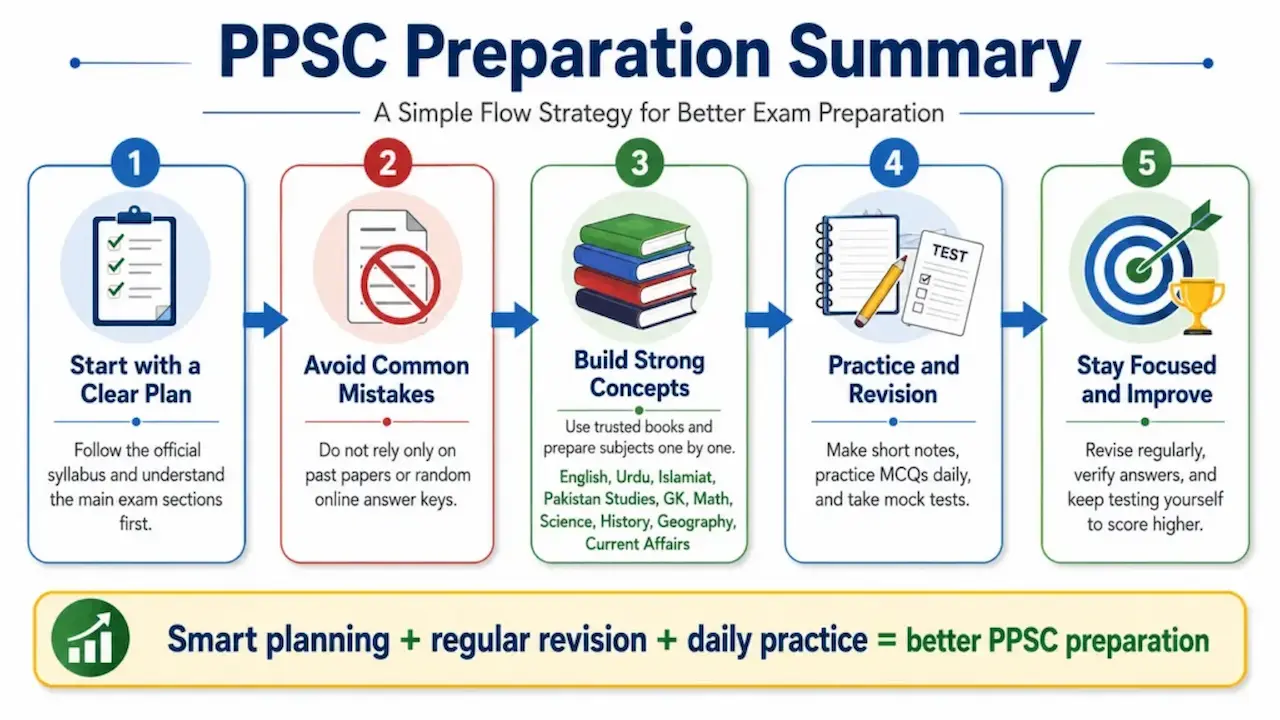
Mistake 1: Studying Without the Official Syllabus
Every year, candidates waste weeks studying topics that are not even in the PPSC syllabus for their specific post. Always download the official syllabus from ppsc.gop.pk before opening a single book.
Mistake 2: Reading Books Without Practicing MCQs
Reading builds knowledge. MCQ practice builds exam skill. You need both. A ratio of 60 percent reading and 40 percent practice is ideal.
Mistake 3: Ignoring Current Affairs Until the Last Week
Current affairs cannot be crammed. You need minimum 4 to 6 weeks of regular current affairs reading to retain it properly. Start from day one.
Mistake 4: Attempting No Mock Tests
Many students skip mock tests because they “don’t feel ready yet.” This is backwards. Mock tests show you where you’re weak so you can fix it before the real exam.
Mistake 5: Comparing Their Progress With Others
PPSC preparation is a personal journey. Social media makes students anxious about what others are doing. Focus on your plan, your schedule, your improvement.
FAQs About PPSC Exam Preparation
Q1: Is 3 months enough to prepare for PPSC?
Yes, 3 months is sufficient for most PPSC posts if you follow a structured daily plan covering all subjects, practice MCQs regularly, and complete mock tests in the final month. Candidates with weaker foundational knowledge may benefit from 4 to 5 months.
Q2: How many MCQs should I practice daily for PPSC?
Aim for a minimum of 50 to 100 MCQs per day spread across 2 to 3 subjects. Platforms like MCQsDrive offer unlimited free practice MCQs across all PPSC subjects.
Q3: Which subject carries the most marks in PPSC One Paper?
Pakistan Studies, General Knowledge, and Current Affairs combined typically account for 35 to 45 percent of most PPSC One Paper tests. These should receive maximum preparation time.
Q4: Can I prepare for PPSC while working a full-time job?
Yes. Many successful PPSC candidates prepare while working full-time. The key is consistency 3 to 4 focused study hours daily is more effective than 8 unfocused hours on weekends only.
Q5: What is the passing score for PPSC One Paper MCQ test?
PPSC does not publish a fixed passing score. Selection is merit-based candidates are ranked by score and selected against available vacancies. A score above 70 out of 100 is generally considered competitive for most posts.
Conclusion: Your PPSC Success Starts Today
PPSC exam preparation in 3 months is not a shortcut it is a smart system. The candidates who clear this exam are not necessarily the most brilliant. They are the most consistent, the most disciplined, and the most strategic with their time.
Here is what to do right now:
- Download your post-specific PPSC syllabus from ppsc.gop.pk today
- Set up your daily 4-hour study schedule starting tomorrow
- Bookmark MCQsDrive.com for daily MCQ practice across all subjects
- Buy one good GK book and one subject-specific MCQs book
- Start your Dawn newspaper habit from tomorrow morning
Ninety days from now, you will either be grateful you started today or wishing you had.
The exam is the same for everyone. The preparation is not. Make yours count.