PPSC Past Papers 2026: Solved MCQs, Answers & Practice Tests
Preparing for a Punjab Public Service Commission (PPSC) exam requires a clear study plan, regular practice, and a good understanding of the test pattern. Whether you are applying for a lecturer, assistant, inspector, medical officer, or another government position, solving past papers can help you prepare with more confidence.
PPSC Past Papers 2026 are a useful starting point for candidates who want to practise multiple-choice questions (MCQs), review important subjects, and improve their time management. By studying previous questions and practising similar MCQs, you can identify weak areas and focus on the topics that need more attention.
On MCQsDrive, candidates can use subject-wise MCQs and practice questions to support their preparation. This guide explains how to use PPSC past papers, which subjects to study, and how to prepare effectively for the written examination.
What Are PPSC Past Papers?
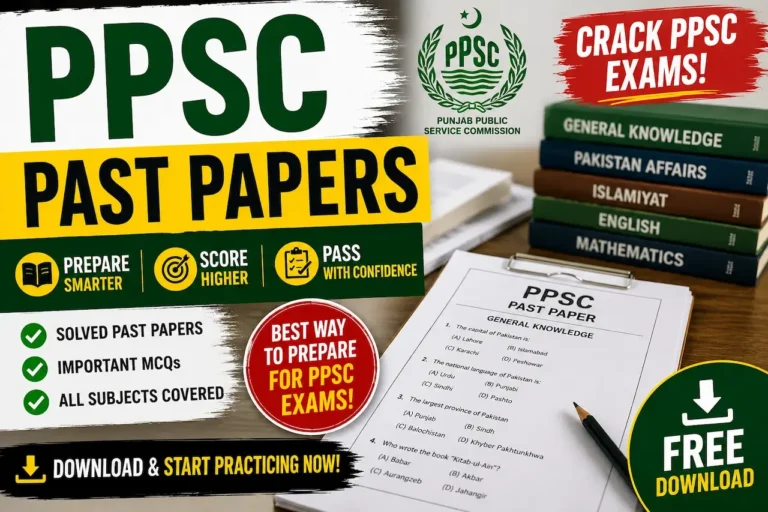
PPSC past papers are previous examination papers or collections of questions used in tests conducted by the Punjab Public Service Commission. They help candidates understand the style of questions, the level of difficulty, and the subjects that may be included in a written test.
These papers are especially useful when preparing for a specific government job. For example, the preparation required for a lecturer post may differ from that required for an assistant, sub-inspector, or technical position.
PPSC past papers with answers are even more helpful because they allow candidates to check their responses and understand which topics require further study.
However, previous papers should be used as a study resource rather than a guarantee of future questions. The syllabus and test pattern can vary according to the post and the official advertisement.
Why Should You Solve PPSC Past Papers 2026?
Solving past papers is one of the most practical ways to prepare for a competitive examination. Reading books and notes is important, but answering MCQs helps you test what you have actually learned.
Here are some key benefits.
1. Understand the Test Pattern
Past papers can help you become familiar with the question format and the types of topics tested in previous examinations. This makes it easier to plan your preparation according to the relevant post.
2. Identify Important Topics
Repeated practice can help you identify subject areas that deserve more attention. However, the appearance of a topic in previous papers does not mean it will necessarily appear again.
3. Improve Time Management
PPSC written tests may require candidates to answer many questions within a limited time. Practising under timed conditions helps you make decisions more quickly without sacrificing accuracy.
4. Find Your Weak Areas
When you review your mistakes, you can identify topics that need revision. Instead of studying everything again, you can spend more time on areas where you consistently lose marks.
5. Build Confidence
Regular practice makes the exam format more familiar. As you improve your accuracy and speed, you can approach the actual examination with better preparation.
Important Subjects for PPSC Exam Preparation
The subjects included in a PPSC written test depend on the post, its syllabus, and the official test instructions. Some general recruitment tests may include a combination of general knowledge, language, current affairs, and other subjects.
Candidates should always check the official advertisement and syllabus before deciding how much time to spend on each subject.
General Knowledge
General knowledge is useful for many competitive examinations. Prepare topics such as world geography, important historical events, international organizations, scientific discoveries, and notable personalities.
Practise general knowledge MCQs regularly and revise the questions you answer incorrectly.
Pakistan Studies
Pakistan Studies preparation may include the Pakistan Movement, important constitutional developments, national history, geography, and major events after independence.
Focus on understanding important events and dates instead of memorizing facts without context.
Current Affairs
Current affairs questions may cover Pakistan’s national affairs, international relations, economic developments, major appointments, and significant world events.
Use reliable news sources and official announcements. Review recent developments regularly, and keep your notes organized by date and topic. Because current affairs change quickly, check that your study material is up to date.
English
English is another useful area for competitive-test preparation. Common practice topics include:
- Synonyms and antonyms
- Grammar and sentence correction
- Prepositions
- Active and passive voice
- Direct and indirect speech
- Idioms and phrases
- Reading comprehension
Practise a few English MCQs every day and learn why an answer is correct.
Everyday Science
Everyday science questions may cover basic physics, chemistry, biology, the human body, environmental science, and common scientific principles.
Focus on basic concepts and practical examples. Understanding a concept usually makes it easier to answer questions that are written differently from the examples in your notes.
Mathematics and Analytical Reasoning
Depending on the post, the test may include percentages, ratios, averages, number series, basic arithmetic, logical reasoning, or other quantitative questions.
Practise solving these questions without relying on a calculator unless the official test instructions permit one.
Subject-Specific Knowledge
For professional and technical posts, subject-related knowledge may be especially important. Lecturers, engineers, medical professionals, and other specialists should review the syllabus for their particular position.
Do not assume that every PPSC examination follows the same subject distribution.
How to Prepare with PPSC Past Papers with Answers
Having access to past papers is only the first step. The way you use them determines how much you learn from your practice.
Follow this simple method.
Step 1: Check the official syllabus
Read the advertisement and syllabus for your specific post. Note the subjects, marks distribution, and test instructions where these are provided.
Step 2: Solve a paper without checking the answers
Attempt the questions independently. Set a timer if you know the official test duration. This helps you measure your current preparation level.
Step 3: Check your answers carefully
Compare your responses with a reliable answer key. If an answer seems doubtful, verify it using a trustworthy textbook or official source.
Step 4: Review every mistake
Write down the question, the correct answer, and a short explanation. This creates a personal revision list that you can use before the exam.
Step 5: Practise weak subjects
If you regularly make mistakes in English grammar or mathematics, spend additional time practising those areas. Do not focus only on subjects you already find easy.
Step 6: Repeat the test
After revising your weak areas, solve another paper or a fresh set of MCQs. Compare your accuracy and completion time with your earlier attempt.
PPSC Practice Tests and Solved MCQs
PPSC practice tests help candidates check their preparation before the actual examination. A good practice session should include questions from the relevant syllabus, a clear answer key, and explanations wherever possible.
You can use MCQsDrive to practise general knowledge, English, Pakistan Studies, everyday science, and other available subjects. Choose the topics related to your target post and revise the answers after each session.
For the best results, follow these rules:
- Attempt questions before viewing their answers.
- Avoid memorizing answer letters without understanding the facts.
- Keep a record of incorrect responses.
- Repeat difficult questions after a few days.
- Use timed practice to improve speed.
- Verify factual answers when different sources disagree.
Remember that a practice quiz is a learning tool. Its score does not guarantee your result in the official PPSC examination.
A Simple 7-Day PPSC Preparation Plan
If your examination is approaching, a short revision plan can help you organize your time.
Day 1: Review the official syllabus and take a short diagnostic test.
Day 2: Practise general knowledge and Pakistan Studies MCQs.
Day 3: Revise English grammar, vocabulary, and sentence correction.
Day 4: Study current affairs using reliable and recent sources.
Day 5: Practise everyday science and the subjects relevant to your post.
Day 6: Solve a full practice paper under timed conditions, using the official test duration where available.
Day 7: Review incorrect answers, revise important facts, and revisit difficult topics.
Adjust this plan according to your available study time and the requirements of your examination. If your post requires substantial professional knowledge, give that subject the time it deserves.
Common Mistakes to Avoid During PPSC Preparation
Many candidates spend hours studying but do not review their progress. Avoid these common mistakes:
Studying without checking the syllabus: You may waste time on topics that are not relevant to your post.
Memorizing outdated information: Current affairs and official rules can change, so check the dates and sources of your material.
Trusting every answer key: Online MCQs can contain mistakes. Verify questionable answers before memorizing them.
Ignoring weak subjects: Repeatedly practising familiar questions may feel easy, but it does not address your learning gaps.
Practising without a timer: Untimed practice alone may not prepare you for the pressure of the actual examination.
Relying only on past papers: Previous papers are valuable, but they should be combined with syllabus-based study and concept revision.
Frequently Asked Questions (FAQs)
Where can I find PPSC Past Papers 2026?
You can explore PPSC-related MCQs and subject-wise practice material on MCQsDrive. Also check the official Punjab Public Service Commission website for current advertisements, syllabuses, and examination instructions.
Are PPSC past papers with answers useful for preparation?
Yes. They help you practise question formats, check your knowledge, and identify weak subjects. Their usefulness depends on the accuracy of the answer key and how closely the material matches your target examination.
Which subjects should I prepare for PPSC exams?
The subjects depend on the post and its official syllabus. General knowledge, Pakistan Studies, English, current affairs, and everyday science may be relevant to some tests, while professional posts can require substantial subject-specific preparation.
Are questions repeated in PPSC examinations?
Some topics or question styles may appear in more than one examination, but repetition is not guaranteed. Prepare concepts and the official syllabus rather than relying on predictions about exact questions.
How can I improve my PPSC test score?
Practise relevant MCQs, review incorrect answers, revise weak topics, follow the official syllabus, and complete timed practice tests. Regular revision and accurate study material can help improve your performance.
Does practising past papers guarantee selection?
No. Past papers support preparation, but selection depends on the applicable examination process, your performance, eligibility, and other official requirements.
Final Words
PPSC Past Papers 2026 can be a useful part of your preparation for Punjab Public Service Commission examinations. They help you become familiar with MCQs, review important subjects, improve time management, and recognize the areas where you need more practice.
Start by checking the official syllabus for your target post. Then solve past papers, verify your answers, and revise your mistakes regularly. Use subject-wise MCQs and practice tests on MCQsDrive to support your daily study routine.
Consistent practice, reliable information, and a clear study plan are more useful than memorizing large numbers of questions without understanding them. Prepare according to your examination requirements, track your progress, and keep improving one topic at a time.