Pedagogy MCQs for Punjab School Educator and SST Jobs 2026 with Answers
If you are preparing for a teaching job in Punjab, pedagogy MCQs for Punjab School Educator and SST jobs are among the most important questions you need to master. Almost every educator recruitment test includes a professional section on teaching methods, learning theories, child development and assessment. Many candidates score well in general knowledge and English but lose easy marks here because they never study pedagogy in a structured way.
This guide gives you a clear overview of the pedagogy syllabus, 20 solved pedagogy MCQs with short explanations, and a practical study plan. By the end, you will know exactly what to study and how to answer these questions with confidence.
What Is Pedagogy and Why Does It Matter in Educator Tests?
Pedagogy is the science and art of teaching. It explains how teachers plan lessons, how students learn, and how teachers measure that learning. Recruiters test pedagogy because they want to hire teachers who understand children, not just subjects.
For School Educator (primary and elementary) and SST (Secondary School Teacher) posts, pedagogy questions check whether you can:
Understand how children think and grow at different ages, choose the right teaching method for a lesson, manage a classroom effectively, and assess students fairly.
A strong pedagogy score often decides merit, because most candidates score similarly in the subject sections.
Pedagogy Syllabus for Punjab School Educator and SST Tests
Pedagogy questions in educator tests usually come from these core areas:
Educational psychology: learning theories, motivation, intelligence, and individual differences.
Child development: Piaget’s stages, Vygotsky’s ideas, and physical, social and emotional growth.
Teaching methods: lecture, discussion, demonstration, project, heuristic, inquiry and activity-based methods.
Lesson planning: Herbartian steps, learning objectives and Bloom’s taxonomy.
Assessment and evaluation: formative and summative assessment, reliability, validity and test types.
Classroom management and inclusive education: discipline, student engagement, and children with special needs.
Famous educationists: Comenius, Froebel, Montessori, Dewey and others.
Always read the official advertisement for your specific post, because the exact test pattern and syllabus can change from one recruitment cycle to the next.
Pedagogy MCQs with Answers (Solved)
Practice these pedagogy MCQs carefully. Read the explanation even when you get the answer right, because examiners often ask the same concept in a different way.
1. Who is known as the father of modern education?
A) John Dewey B) John Amos Comenius C) Plato D) Rousseau
Answer: B) John Amos Comenius. He promoted universal education and the use of pictures in teaching.
2. Who founded the Kindergarten system?
A) Maria Montessori B) Friedrich Froebel C) Pestalozzi D) Herbart
Answer: B) Friedrich Froebel. He called the school a “garden of children.”
3. The Zone of Proximal Development (ZPD) was introduced by:
A) Piaget B) Skinner C) Lev Vygotsky D) Bruner
Answer: C) Lev Vygotsky. ZPD is the gap between what a child can do alone and what the child can do with guidance.
4. According to Piaget, the concrete operational stage covers which age?
A) 0–2 years B) 2–7 years C) 7–11 years D) 11 years and above
Answer: C) 7–11 years. Children start thinking logically about real, concrete objects.
5. The lowest level of the cognitive domain in revised Bloom’s taxonomy is:
A) Understanding B) Remembering C) Applying D) Creating
Answer: B) Remembering. In the original taxonomy, this level was called “Knowledge.”
6. Operant conditioning is associated with:
A) Pavlov B) B.F. Skinner C) Thorndike D) Köhler
Answer: B) B.F. Skinner. Behaviour changes through reinforcement and punishment.
7. Classical conditioning was presented by:
A) Ivan Pavlov B) Watson C) Skinner D) Bandura
Answer: A) Ivan Pavlov. He demonstrated it through his famous experiment with dogs.
8. The theory of multiple intelligences was given by:
A) Alfred Binet B) Howard Gardner C) Spearman D) Thurstone
Answer: B) Howard Gardner. He argued that intelligence has several forms, such as linguistic, logical and musical.
9. “Learning by doing” is the principle of:
A) John Dewey B) Froebel C) Plato D) Herbart
Answer: A) John Dewey. He linked education closely with real-life experience.
10. The main purpose of formative assessment is to:
A) Grade students at year end B) Improve learning during teaching C) Promote students D) Rank schools
Answer: B) Improve learning during teaching. Teachers use it to give feedback while learning is still happening.
11. The hierarchy of needs was proposed by:
A) Abraham Maslow B) Carl Rogers C) Freud D) Erikson
Answer: A) Abraham Maslow. Physiological needs sit at the base and self-actualization at the top.
12. The first step of the Herbartian lesson plan is:
A) Presentation B) Preparation C) Application D) Generalization
Answer: B) Preparation. The teacher connects new knowledge to what students already know.
13. Reliability of a test refers to its:
A) Accuracy B) Consistency C) Difficulty D) Length
Answer: B) Consistency. A reliable test gives similar results when repeated under similar conditions.
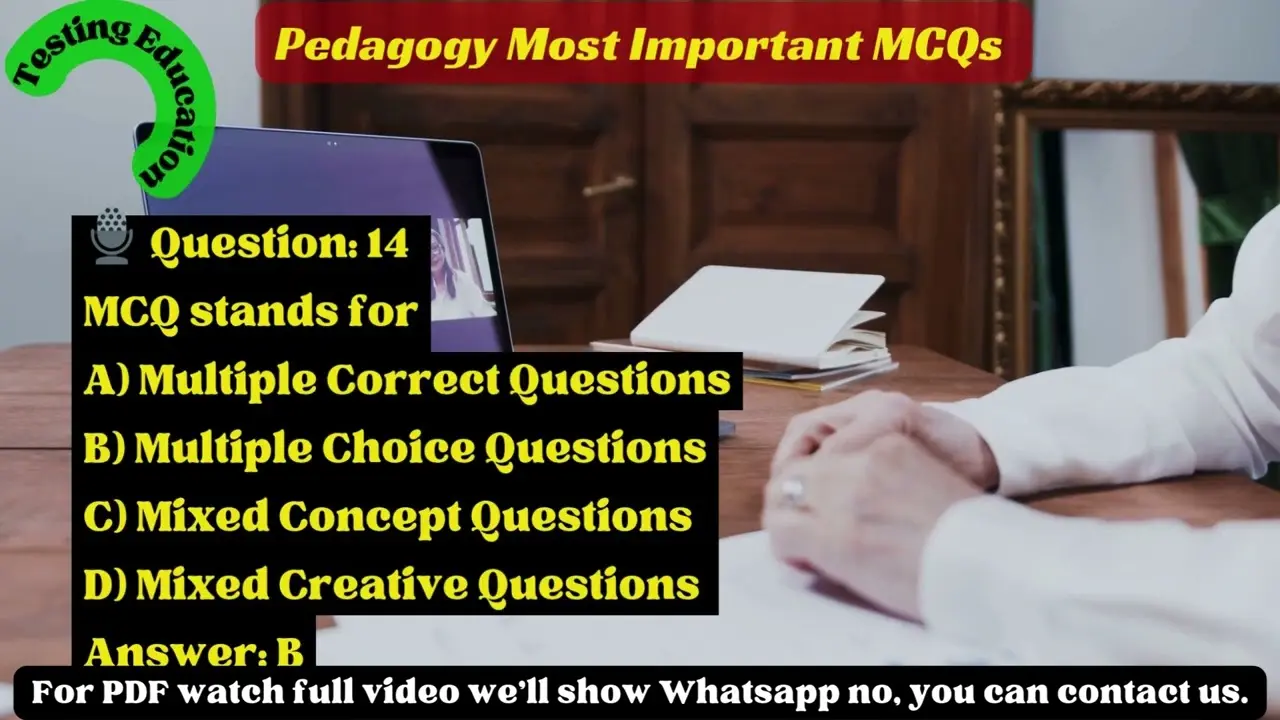
14. Validity of a test means:
A) It is easy to mark B) It measures what it intends to measure C) It is short D) It is objective
Answer: B) It measures what it intends to measure.
15. The heuristic method of teaching was introduced by:
A) H.E. Armstrong B) Dewey C) Kilpatrick D) Montessori
Answer: A) H.E. Armstrong. Students discover facts themselves, as a researcher would.
16. The Montessori method mainly emphasizes:
A) Rote learning B) Sense training and self-directed activity C) Strict punishment D) Lecture
Answer: B) Sense training and self-directed activity.
17. Discovery learning is closely associated with:
A) Jerome Bruner B) Pavlov C) Thorndike D) Gagné
Answer: A) Jerome Bruner. Learners build knowledge by exploring and solving problems.
18. Microteaching was first developed at:
A) Oxford University B) Stanford University C) Harvard University D) Cambridge University
Answer: B) Stanford University. It trains teachers in one skill at a time with a small group and short lesson.
19. The “trial and error” theory of learning was given by:
A) Edward Thorndike B) Köhler C) Skinner D) Piaget
Answer: A) Edward Thorndike. He also gave the laws of readiness, exercise and effect.
20. Inclusive education means:
A) Separate schools for disabled children B) Teaching children with special needs in regular classrooms C) Only private schooling D) Home schooling
Answer: B) Teaching children with special needs in regular classrooms.
For hundreds more solved questions, practise the full Pedagogy MCQs section on MCQsDrive.
How to Prepare Pedagogy MCQs Smartly
You do not need to memorize entire textbooks. Follow this focused approach:
Learn theorists in pairs. Link every name with one key idea, for example Vygotsky with ZPD and Skinner with reinforcement. Most pedagogy MCQs test exactly this link.
Make a one-page chart of Piaget’s stages, Bloom’s taxonomy levels and the Herbartian steps. Revise it every day.
Practise daily in timed sets. Solve 25 to 30 pedagogy MCQs in 15 minutes, then review every wrong answer.
Understand, don’t just memorize. Examiners often ask scenario-based questions, such as which method suits a science lesson. When you understand the concept, you can answer any version of the question.
Attempt mock tests in the last two weeks. Use the quiz mode on MCQsDrive to build speed and accuracy.
Frequently Asked Questions
Is pedagogy included in the Punjab School Educator test?
Yes. Educator recruitment tests in Punjab usually include a professional section that covers pedagogy, teaching methods and educational psychology. Check the official advertisement for the exact pattern.
Which topics are most important in pedagogy MCQs?
Learning theories, Piaget’s stages, Bloom’s taxonomy, teaching methods, assessment, and famous educationists appear most often.
Are pedagogy MCQs the same for School Educator and SST tests?
The core topics are similar. SST tests may ask slightly deeper questions on assessment, lesson planning and secondary-level teaching methods.
How many days do I need to prepare pedagogy?
With one to two hours of daily practice, most candidates can cover the core pedagogy syllabus in three to four weeks.
Conclusion
Pedagogy is one of the most scoring sections in Punjab School Educator and SST tests, because the questions come from a fixed set of concepts and theorists. Learn the core theories, revise your charts daily, and practise solved pedagogy MCQs in timed sets. Start today with the full Pedagogy MCQs collection, then test yourself in quiz mode to track your progress.