Intelligence and IQ Test MCQs for ISSB, Police and Armed Forces Tests
Intelligence and IQ test MCQs are a key part of the selection process for the Pakistan Army, Navy, Air Force, ISSB and police departments. These tests check how quickly you think, spot patterns and solve problems under time pressure. The good news is that anyone can improve their score with the right practice. In this guide, you will learn the main question types, see solved examples with explanations, and get proven tips to clear your intelligence test on the first attempt.
What Is an Intelligence or IQ Test?
An intelligence test measures your reasoning ability rather than your academic knowledge. It does not ask what you learned in school. Instead, it checks how well you understand relationships between numbers, words, shapes and ideas.
Recruiters use these tests because they predict how a candidate will perform in training and in the field. A soldier, officer or police constable must make quick and accurate decisions, and an IQ test shows whether a candidate has that mental sharpness.
Most intelligence tests in Pakistan come in two forms:
Verbal intelligence test: Questions use words, letters and numbers. You solve series, analogies, coding-decoding, blood relations and direction problems.
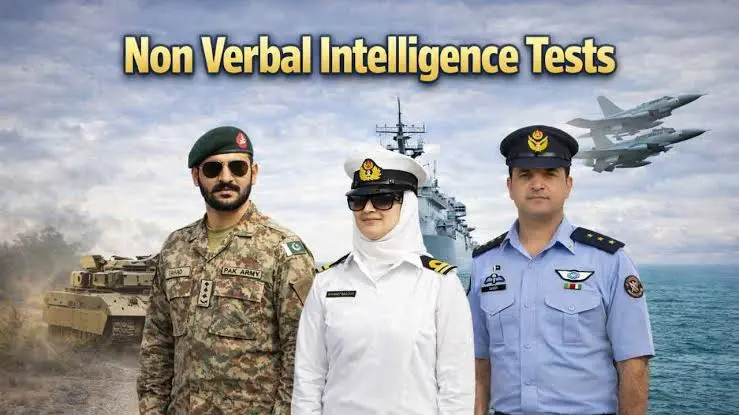
Non-verbal intelligence test: Questions use figures and shapes. You find the missing figure, the odd figure, mirror images or the next shape in a pattern.
Where Are Intelligence Tests Used in Pakistan?
Intelligence tests appear in almost every uniformed-service recruitment process. Candidates face them in Pakistan Army initial tests for commission and soldier entries, in Pakistan Navy and PAF initial selection, at the ISSB stage for officer selection, and in police recruitment tests for constable, ASI and other posts. Some other government departments, including FIA and ASF, also include reasoning sections in their written tests.
In most of these tests, you get a fixed number of questions and very limited time, often less than a minute per question. That is why speed matters as much as accuracy.
Main Types of Intelligence and IQ Test MCQs
Understanding the question types helps you prepare smartly. Here are the categories you will see most often:
- Number series: Find the next or missing number in a sequence.
- Letter series: Find the next letter based on a pattern of positions.
- Analogies: Identify a relationship between two items and apply it to another pair.
- Odd one out: Pick the item that does not belong to the group.
- Coding-decoding: Crack a code and apply it to a new word.
- Blood relations: Work out family relationships from a statement.
- Direction sense: Track movement and find the final position.
- Ranking and order: Find positions or total numbers in a row.
- Calendar and clock: Solve questions about days, dates and clock angles.
- Non-verbal figures: Complete patterns, find mirror images and match shapes.
Solved Intelligence and IQ Test MCQs with Explanations
Practice these solved IQ test MCQs to understand the logic behind each type. Try to answer each one before you read the explanation.
1. Find the next number: 2, 6, 12, 20, 30, ?
A) 40 B) 42 C) 44 D) 36
Answer: B) 42
The differences are 4, 6, 8, 10, so the next difference is 12. 30 + 12 = 42.
2. Find the next number: 5, 11, 23, 47, ?
A) 94 B) 95 C) 96 D) 99
Answer: B) 95
Each number is doubled and then increased by 1. 47 × 2 + 1 = 95.
3. Find the next letter: A, C, F, J, O, ?
A) T B) S C) U D) V
Answer: C) U
The gaps grow by one each time: +2, +3, +4, +5, +6. O is the 15th letter, and 15 + 6 = 21, which is U.
4. Book is to Author as Painting is to:
A) Canvas B) Painter C) Gallery D) Brush
Answer: B) Painter
An author creates a book, and a painter creates a painting.
5. Which one is the odd one out?
A) Apple B) Mango C) Potato D) Banana
Answer: C) Potato
Potato is a vegetable, while the others are fruits.
6. If CAT is written as DBU, how will DOG be written?
A) EPH B) EPG C) FPH D) DPH
Answer: A) EPH
Each letter moves one step forward: D becomes E, O becomes P and G becomes H.
7. Pointing to a boy, Sara says, “He is the son of my mother’s only son.” How is the boy related to Sara?
A) Brother B) Son C) Nephew D) Cousin
Answer: C) Nephew
Sara’s mother’s only son is Sara’s brother. His son is Sara’s nephew.
8. Ali walks 5 km north, turns right and walks 3 km, then turns right again and walks 5 km. How far is he from the starting point?
A) 3 km east B) 5 km north C) 8 km east D) 3 km west
Answer: A) 3 km east
The north and south walks cancel each other out, leaving Ali 3 km east of his starting point.
9. Ahmed is 7th from the top and 18th from the bottom in a class. How many students are in the class?
A) 25 B) 24 C) 23 D) 26
Answer: B) 24
Total = position from top + position from bottom − 1, so 7 + 18 − 1 = 24.
10. If today is Monday, what day will it be after 61 days?
A) Friday B) Saturday C) Sunday D) Thursday
Answer: B) Saturday
61 divided by 7 leaves a remainder of 5. Five days after Monday is Saturday.
11. What is the angle between the hour and minute hands at 3:00?
A) 45° B) 60° C) 90° D) 120°
Answer: C) 90°
Each hour mark is 30° apart, and 3 hours × 30° = 90°.
12. Find the next number: 3, 9, 27, 81, ?
A) 162 B) 243 C) 324 D) 216
Answer: B) 243
Each number is multiplied by 3. 81 × 3 = 243.
For hundreds of more questions, practice our complete Intelligence MCQs and Verbal and Non-Verbal Reasoning sections on MCQsDrive.
How to Prepare for the Intelligence Test: 7 Proven Tips
Practice daily with a timer. Solve 30 to 40 questions every day under timed conditions. This builds speed and trains your brain to recognize patterns quickly.
Learn the common patterns. Most series questions use addition, multiplication, squares, cubes or alternating patterns. Once you know these, many questions take only seconds.
Memorize letter positions. Knowing that A = 1, E = 5, J = 10, O = 15 and T = 20 saves a lot of time in letter series and coding questions.
Skip and return. If a question takes more than 40 seconds, move on. Come back to it once you have answered the easier ones.
Draw diagrams. For direction and blood relation questions, a quick sketch on rough paper prevents confusion.
Train your eyes for figures. For non-verbal tests, check shapes one feature at a time: rotation, number of lines, shading and position.
Take full mock tests. Attempt complete practice tests at least twice a week to build stamina and manage exam pressure. You can create a custom quiz on MCQsDrive using the Quiz Mode feature.
Common Mistakes Candidates Should Avoid
Many candidates lose marks not because the questions are hard, but because they make avoidable errors. They rush through the question and misread “left” as “right” or “brother” as “sister.” Others spend too long on one difficult question and leave easy ones unanswered at the end. Some candidates also prepare only verbal questions and ignore non-verbal figures, even though both sections carry marks. Finally, many skip practice in the final week. Consistent practice keeps your mind sharp until test day.
Frequently Asked Questions
What is the passing score in an intelligence test for the Pakistan Army?
The Army does not publish a fixed passing score. Selection depends on overall performance and the number of candidates, so aim to answer as many questions correctly as you can.
Can I improve my IQ test score with practice?
Yes. Regular practice of intelligence and IQ test MCQs makes you faster and more accurate because you learn to recognize repeated patterns.
What is the difference between verbal and non-verbal intelligence tests?
Verbal tests use words, numbers and letters, while non-verbal tests use shapes and figures. Most armed forces tests include both.
How many questions come in an ISSB or initial intelligence test?
The number of questions and the time limit vary by force and entry. Expect a large number of questions with very little time each, so speed practice is essential.
Is the intelligence test difficult for police jobs?
Police intelligence questions are usually basic to moderate in difficulty. With two to three weeks of focused practice, most candidates can score well.
Final Words
Intelligence and IQ test MCQs reward practice, not luck. When you understand the question types, learn the common patterns and practice daily with a timer, you can clear this stage with confidence. Start today with the solved examples above, then move on to the full practice sets on MCQsDrive to sharpen your skills for ISSB, police and armed forces tests.