
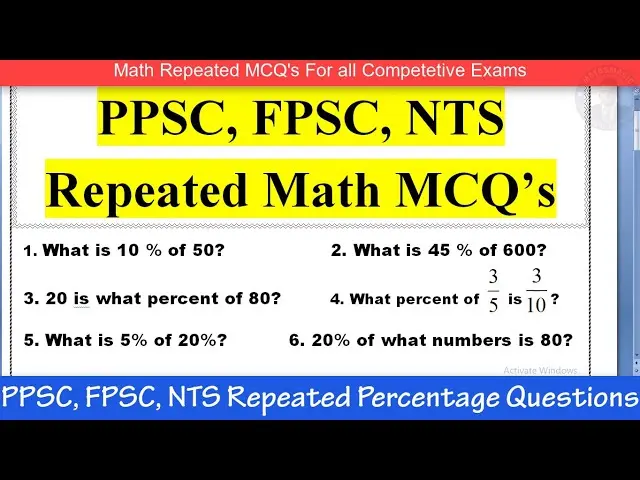
Maths MCQs for PPSC, FPSC & NTS: Topic-Wise Practice
Maths is the section most candidates leave for last, and it is the section that quietly costs them the merit list. The questions are not difficult. They are timed.
We have seen firsthand that candidates who practise maths MCQs topic by topic clear the written stage far more often than those who solve mixed papers at random. This guide shows you exactly how to do that.
Why Maths MCQs Decide Your Final Position
In a one-paper PPSC or FPSC screening test of 100 questions, quantitative reasoning commonly carries 10 to 20 questions. In NTS-format papers, the quantitative portion is usually larger — often a quarter of the paper. Always confirm the exact weightage from the official advertisement for your post, because it shifts between BS-14, BS-16 and BS-17 cadres.
That weight matters for a specific reason. General Knowledge and Current Affairs are recall-based, so most serious candidates score similarly there. Maths is skill-based, which means the gap between a prepared candidate and an unprepared one is much wider. When merit is decided by two or three marks, that gap is the whole contest.
There is a second reason we push maths hard with our users. Maths answers are objectively verifiable. You either arrive at the correct value or you do not. That makes it the most reliable section to convert into guaranteed marks, unlike current affairs where the examiner’s cut-off date can work against you.
The Topics That Actually Repeat
We analysed the arithmetic questions appearing across recent PPSC, FPSC and NTS papers, and the pattern is narrow. Roughly eight to ten topics generate the majority of questions. Preparing all thirty topics equally is a waste of your limited weeks.
Start with this high-frequency core:
- Percentage — the single most tested topic, and the base for profit, discount and interest questions
- Ratio and Proportion — appears directly and inside partnership and mixture problems
- Profit and Loss — cost price, selling price and marked price relationships
- Time and Work — pipes, workers and combined efficiency
- Average — including weighted averages and average after replacement
- Time and Distance — relative speed, trains and journeys
- Simple and Compound Interest — two-year and three-year compounding
- Simplification and Approximation — BODMAS-based speed questions
Once the core is secure, move to the second tier: LCM and HCF, Mensuration, Partnership, Pipes and Cisterns, Mixtures and Allegations, and Odd Man Out Series.
Leave Probability, Permutations and Combinations and Height and Distance for the end. They appear, but rarely more than one question each.
How We Structure a 30-Day Maths Plan
We always advise candidates to work in fixed topic blocks rather than solving random papers daily. Random practice feels productive and teaches you nothing about your weak areas.
Days 1 to 12 — Core topics. Take one topic per day from the high-frequency list. Solve 25 to 30 maths MCQs of that topic in a single sitting, untimed. Your only goal is to understand the method, not speed.
Days 13 to 20 — Second tier. Same routine, one topic per day, but now cap yourself at 60 seconds per question. You should start noticing which topics you consistently overshoot on.
Days 21 to 26 — Mixed timed sets. Build 20-question sets pulling from all covered topics. Give yourself 20 minutes. Record your score and, more importantly, record which topic each wrong answer belonged to.
Days 27 to 30 — Error correction only. Do not learn anything new. Return to the three topics that produced the most errors and redo those question banks completely.
This sequence works because it separates learning from testing. Most candidates fail because they attempt both at once and end up doing neither properly.
Shortcut Methods Worth Memorising
Exam maths is not academic maths. You are not being graded on method, only on the marked answer. That changes what you should practise.
- Percentage to fraction conversion. Memorise the common ones: 12.5% = 1/8, 16.67% = 1/6, 33.33% = 1/3, 62.5% = 5/8. Converting before calculating cuts most percentage questions in half.
- Successive percentage change. For two changes of a% and b%, use a + b + (ab/100). A 20% rise followed by a 20% fall gives −4%, not zero.
- Time and work reciprocals. If A finishes in 12 days and B in 18, work with 1/12 and 1/18, or use the LCM method by treating total work as 36 units.
- Option elimination. Check the last digit or the approximate magnitude of the answer first. In approximation questions, rounding often eliminates three options instantly.
- Skip discipline. If a question is not moving within 45 seconds, mark it and move on. One question is never worth three.
Mistakes We See Repeated Every Cycle
We prioritise a strategy of fixing behaviour before adding content, because the same errors appear again and again in candidate feedback:
- Solving with a calculator during practice, then facing a paper where none is allowed
- Reading the solution before genuinely attempting the question
- Practising only easy topics because the score looks encouraging
- Ignoring the answer explanation after getting a question right by guessing
- Never practising under a clock until the week of the exam
The last one is the most damaging. Accuracy without speed produces the same result as no preparation at all.
Practising Maths MCQs the Right Way
Attempt each set on our topic pages in one uninterrupted sitting, then review every explanation — including the questions you answered correctly. Understanding why the other three options were wrong is what protects you when the examiner rephrases the same concept.
Keep a single notebook for formulas you got wrong, not formulas in general. By exam week that notebook should be under two pages. If it is longer, you have been copying rather than reviewing.
Finally, repeat each topic set after a ten-day gap. Spaced repetition holds arithmetic methods far better than back-to-back drilling.
Why Choose Us
We built our maths section around what actually appears in Pakistani competitive papers rather than a general textbook syllabus.
- 30 dedicated maths topic pages, each with a standalone question bank
- Explanations written for exam shortcuts, not classroom derivations
- Free access with no registration barrier before you start practising
- A customised quiz generator so you can build timed sets from any combination of topics
- Regular additions based on the question patterns candidates report after each paper
Conclusion
Maths is the most controllable section in your entire paper. Fix eight core topics, practise them under a clock, and review your errors by topic rather than by score. Start with percentage and ratio and proportion, then build outward. The marks are there for anyone willing to be systematic.
FAQs
How many maths MCQs come in the PPSC one-paper test?
Quantitative questions commonly range between 10 and 20 out of 100, though this varies by post and cadre. Check the official advertisement for your specific vacancy, as the marks distribution is stated there.
Which maths topics should I prepare first?
Percentage, ratio and proportion, profit and loss, average, and time and work. These five feed into most other arithmetic topics, so preparing them first makes every later topic easier.
Are calculators allowed in PPSC, FPSC or NTS tests?
No. Practise all maths MCQs mentally or on rough paper from day one, otherwise your practice speed will not transfer to the exam hall.
How much time should I spend per maths question?
Aim for 45 to 60 seconds. If a question exceeds that, mark it and return only if time remains after completing the full paper.
Is maths harder than general knowledge in these exams?
Maths requires more practice hours, but it is more reliable. General knowledge depends on recall of unpredictable facts, while maths gives you the same marks every time once the method is secure.