How to Improve General Knowledge for Competitive Exams in Pakistan (2026 Guide)
Quick answer: To improve general knowledge for competitive exams in Pakistan, follow five steps:
- Study your exam’s official syllabus and past papers first.
- Master Pakistan Studies, Islamiyat and current affairs, because these three areas carry most GK marks.
- Read one reliable newspaper every day.
- Solve 50 to 100 GK MCQs daily and review every wrong answer.
- Revise short notes with spaced repetition.
Most candidates who follow this routine for 60 to 90 days see a clear rise in their GK scores in PPSC, FPSC, NTS, CSS and PMS tests.
General Knowledge (GK) decides merit in almost every government job test in Pakistan. The Punjab Public Service Commission (PPSC), the Federal Public Service Commission (FPSC), the National Testing Service (NTS), and provincial commissions like SPSC, KPPSC and BPSC all test GK, from clerical posts up to the CSS exam. Yet most candidates treat GK as “easy marks” and start preparing late. Then a question on Article 25-A, the founding year of the OIC, or the height of K2 costs them their place on the merit list.
This guide gives you a complete, practical system. You will learn:
- what GK actually includes in Pakistani exams,
- which topics examiners repeat most,
- which sources to trust,
- how to build a daily routine, and
- how to remember facts until exam day.
Key Takeaways
- Pakistan Studies, Islamiyat and current affairs together make up the largest share of GK questions in most Pakistani exams.
- Past papers show you exactly which facts examiners repeat. Start with them, not with a thick book.
- Reading alone does not raise your score. Daily MCQ practice turns knowledge into fast, accurate recall.
- Spaced revision (after 1, 3, 7 and 14 days) prevents you from forgetting what you studied.
- One newspaper, one GK book and one MCQ platform are enough. Too many sources slow you down.
What Does General Knowledge Include in Pakistani Competitive Exams?
In Pakistani competitive exams, General Knowledge is not random trivia. It covers a fixed set of subjects that appear again and again across PPSC, FPSC, NTS, SPSC, KPPSC and BPSC papers.
| GK Area | What It Covers | How Often It Appears |
| Pakistan Studies | Geography, history since 1947, Constitution of 1973, national symbols, economy, foreign policy | In almost every exam |
| Islamiyat | Seerat of Prophet Muhammad (PBUH), Quran facts, Islamic history, battles, pillars of Islam | Compulsory in most exams |
| Current Affairs | Recent Pakistani and world events, appointments, agreements, sports, economy | Rising every year |
| World GK | Capitals, currencies, international organizations, geography, inventions | Regular |
| Everyday Science | Human body, diseases, vitamins, basic physics and chemistry, environment | Regular |
| Computer Basics | MS Office, internet terms, hardware and software | Growing, especially in clerical posts |
Pakistan Studies and Pakistan Affairs
Pakistan Studies carries more GK weight than any other area. Examiners test the geography of Pakistan, the Pakistan Movement, constitutional history, national symbols, the economy and foreign relations. If you have limited time, start here. You can practise topic-wise with these Pakistan Studies MCQs.
Islamiyat
Islamiyat questions test basic, well-defined facts: the life of Prophet Muhammad (PBUH), the Holy Quran, the Ashra Mubashara, the pillars of Islam and major battles. These questions are straightforward, so a prepared candidate rarely loses marks here.
Current Affairs
Current affairs cover national and international developments from the last 6 to 12 months. These include new appointments, government decisions, agreements, summits, records and the work of bodies like the UN, IMF, World Bank and SCO. This section changes constantly, so it rewards daily reading more than any other.
World General Knowledge
World GK includes capitals and currencies, the largest and longest geographic features, international organizations and their headquarters, Nobel Prize winners and famous inventions. The scope looks huge, but Pakistani examiners keep returning to the same high-frequency facts.
Everyday Science
Everyday Science tests scientific awareness, not technical depth. Typical topics are the human body, vitamins and deficiency diseases, common physics values, chemical formulas and environmental issues. A non-science student can score well here with steady practice.
Computer and IT Basics
Government departments now run on computers, so many tests include basic IT questions. Expect MS Word and Excel shortcuts, file extensions, internet terms, and hardware versus software concepts. These basic computer MCQs cover the most common patterns.
Why Do Most Candidates Struggle With General Knowledge?
Candidates usually lose GK marks for five reasons:
- They start too late. GK builds up over weeks and months. A two-week crash course cannot cover the full range of facts.
- They use too many sources. Five books on the same topic waste time and create confusion, especially when sources give different figures.
- They read but never test themselves. Recognizing a fact while reading is different from recalling it under time pressure. Without MCQ practice, candidates freeze in the exam hall.
- They ignore current affairs. Many candidates prepare only static GK like history and geography. Recent papers, however, ask more current affairs questions than before.
- They do not revise. The brain drops most new information within days unless you review it. Without revision, even hard study fades by exam day.
How to Improve General Knowledge for Competitive Exams: An 8-Step Strategy
Step 1: Study Your Exam Syllabus and Past Papers First
Download the official syllabus from the PPSC, FPSC, NTS or relevant commission website. Then collect 10 to 15 past papers for your target post. Count how many GK questions appear and which topics repeat.
Exams test GK at different depths:
- PPSC clerical and one-paper tests focus on Pakistan Studies, Islamiyat, current affairs and basic English and Urdu.
- NTS teaching tests add pedagogy and subject knowledge on top of basic GK.
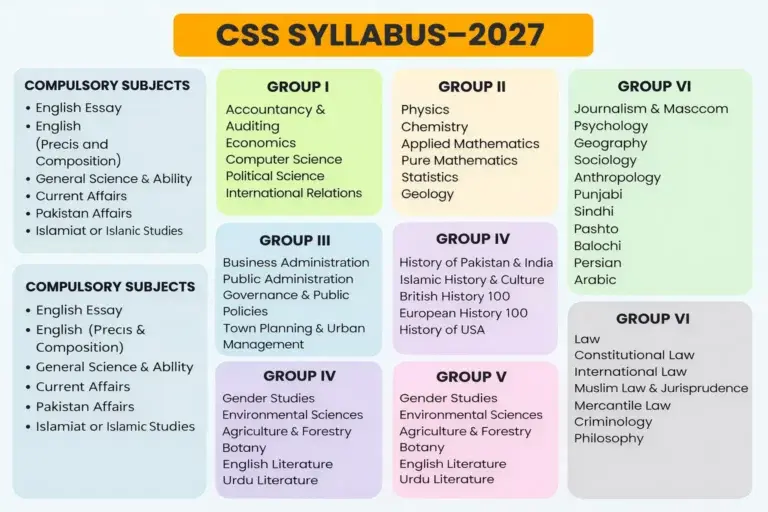
- CSS tests GK in the MPT and demands much deeper knowledge of world affairs and Pakistan affairs.
To see the real pattern, work through the CSS MPT 2027 solved paper or the 500 most important PPSC One Paper MCQs.
Step 2: Build a Strong Foundation in Pakistan Studies
Cover these five core areas.
1. Geography of Pakistan
Learn the provinces, major rivers, dams, mountain ranges, passes and neighbouring countries. Key facts:
- K2, at 8,611 metres, is the highest peak in Pakistan.
- The Indus is the longest river in Pakistan.
- Balochistan is the largest province by area, and Punjab is the largest by population.
- Tarbela Dam stands on the Indus, Mangla Dam on the Jhelum, and the Diamer-Bhasha Dam project on the Indus.
2. History
Cover these milestones in order:
- the Pakistan Movement and the Lahore Resolution of 23 March 1940,
- independence on 14 August 1947,
- the wars with India in 1947–48, 1965 and 1971, and the Kargil conflict of 1999,
- the 1956 and 1962 constitutions,
- martial law periods,
- major political events up to the present.
3. Constitution of 1973
Examiners ask about the Constitution in nearly every paper. Learn these first:
- the Fundamental Rights in Articles 8 to 28,
- Article 2A (Objectives Resolution),
- Article 6 (high treason),
- Article 25-A (right to education),
- Article 251 (national language),
- the structure of Parliament,
- the powers of the President and the Prime Minister,
- major amendments such as the 8th, 18th, 26th and 27th.
4. National symbols
The PPSC and NTS ask these facts year after year:
- Hafeez Jalandhari wrote the national anthem.
- The national animal is the markhor.
- The national bird is the chukar.
- The national flower is the jasmine.
- The national tree is the deodar.
5. Economy and foreign policy
Study CPEC, Pakistan’s relations with China, Saudi Arabia, the USA, Afghanistan and India, and Pakistan’s role in the UN, OIC and SCO.
Step 3: Master Islamiyat Basics
You do not need scholarly depth for general competitive exams. Focus on these four areas.
1. Seerat of the Prophet (PBUH)
Learn his birth, early life and the Hijrah to Madinah. Know the major battles: Badr (2 AH), Uhud (3 AH) and Khandaq (5 AH). Also learn the names of his wives and close companions.
2. The Holy Quran
- The Quran has 114 Surahs and 30 Paras.
- Surah Al-Baqarah is the longest Surah, and Surah Al-Kawthar is the shortest.
- Many scholars call Surah Yaseen the heart of the Quran.
- The first revelation, the opening verses of Surah Al-Alaq, came in the Cave of Hira.
Verse counts differ between sources. The standard count is 6,236, while many Pakistani books quote 6,666. Check which figure your past papers use.
3. Core beliefs and history
Learn the Ashra Mubashara, the five pillars of Islam, the articles of faith, the Rightly Guided Caliphs and important Islamic months and dates.
4. Practice
Reinforce each topic with these Islamiyat MCQs.
Step 4: Follow Current Affairs Every Day
Current affairs reward consistency more than intelligence. Use this routine:
- Read one newspaper daily. Dawn and The Express Tribune are strong English choices. Jang and Express suit Urdu readers. Focus on the front page, national news, international news and one editorial.
- Keep a current affairs notebook. Every week, write 10 to 15 key facts: new appointments, agreements, summits, records and major decisions. Review it every Sunday.
- Practise in two tracks. Solve Pakistan current affairs MCQs for national developments and international current affairs MCQs for global events.
- Prioritize high-yield themes. Focus on Pakistan’s foreign relations, the federal budget and economy, CPEC projects, climate and environment news, and international sports achievements.
Step 5: Study World General Knowledge Strategically
You do not need to memorize every capital in the world. Target the facts examiners repeat:
- Capitals and currencies: Pakistan’s neighbours, major powers (USA, UK, China, Russia, France, Germany) and Muslim countries such as Saudi Arabia, Turkey, Iran and Malaysia.
- International organizations: Learn the headquarters, founding year and purpose of each one:
- UN: New York, founded 1945
- OIC: Jeddah, founded 1969
- SAARC: Kathmandu, founded 1985
- SCO: Beijing
- ASEAN: Jakarta
- ECO: Tehran
- also WHO, IMF, World Bank and NATO
- World geography records: the Pacific is the largest ocean, Asia is the largest continent, Everest is the highest mountain, and Vatican City is the smallest country. Examiners sometimes give either the Nile or the Amazon as the longest river, so follow your past papers.
- Inventions and discoveries: the telephone, aeroplane, printing press, penicillin, radio, computer and internet.
Start with these General Knowledge MCQs with answers to see which world facts appear most.
Step 6: Practise Everyday Science Regularly
Everyday Science questions test awareness, not deep theory. Cover these four areas:
- Human body: an adult has 206 bones, and you should know the main organs and their functions. Also learn vitamins and their deficiency diseases, common diseases and their causes, and basic blood facts.
- Physics: the speed of light and speed of sound, the boiling and freezing points of water, instruments and what they measure, and units.
- Chemistry: common symbols and formulas (H₂O, NaCl, CO₂), acids and bases, and the composition of air. For deeper practice, read these Chemistry MCQs for PPSC, FPSC and SST tests.
- Environment: the greenhouse effect, the ozone layer, global warming and climate agreements.
You will find a large question bank in these Everyday Science MCQs.
Step 7: Solve MCQs Every Day
MCQ practice turns knowledge into marks. It shows you your weak areas and builds the speed you need in a timed paper.
- Solve at least 50 GK MCQs daily during regular preparation.
- Raise the number to 100 in the final three weeks.
- After each session, review every wrong answer and write the correct fact in your notes.
Speed matters as much as accuracy. Learn the 30-second rule for solving MCQs faster, and take full timed online MCQ practice tests every weekend.
Step 8: Revise With Short Notes and Spaced Repetition
Revision fixes facts in long-term memory.
- Make one-page notes for every topic. For example, after you study Pakistan’s rivers, write their names, origins, lengths and the dams on each river on one sheet.
- Use spaced repetition. Revise each topic after 1 day, then after 3 days, 7 days and 14 days. Each review takes less time than the last, and each one strengthens your recall.
- Keep a “mistakes register.” Note every fact you got wrong in practice. Read this register before every mock test.
A 90-Day GK Study Plan
| Phase | Days | Focus | Daily Target |
| Foundation | 1–30 | Pakistan Studies, Constitution, Islamiyat, newspaper habit | 1.5 hours study + 50 MCQs |
| Expansion | 31–60 | World GK, Everyday Science, computer basics, current affairs notebook | 1.5 hours study + 70 MCQs |
| Exam Mode | 61–90 | Past papers, timed mock tests, mistakes register, last 6 months of current affairs | 2 hours + 100 MCQs |
If you have only one month, compress the plan. Use the past-paper approach in this guide on how to crack the NTS test in 30 days.
Daily Habits That Build Strong General Knowledge
- Read for 20 to 30 minutes every morning. You do not need the whole paper. Headlines, national and international pages, and one editorial give you steady awareness.
- Watch one news bulletin. If time is short, a 30-minute Urdu or English bulletin works well. Note names, dates and figures.
- Use YouTube and podcasts wisely. Pakistani educators upload free GK and current affairs content in Urdu, which suits auditory learners. Keep these sessions short and focused.
- Use flashcards for static facts. Capitals, currencies, national symbols and constitutional articles stick faster on flashcards. Review them during commutes or breaks.
- Study with other aspirants. A small study group or WhatsApp group keeps you consistent. Quiz each other and share new facts.
Best Resources for GK Preparation in Pakistan
- Past papers of your target exam. They are the most reliable guide to what examiners actually ask. Start here.
- One standard GK book. Caravan General Knowledge and similar guides cover Pakistan Studies, World GK and Islamiyat in exam format. Pick one and finish it.
- A monthly current affairs magazine. Jahangir’s World Times helps CSS and PMS aspirants with deeper analysis.
- A daily newspaper. Dawn, The Express Tribune, Jang or Express.
- Official government sources. Use these for verified facts and figures:
- the Pakistan Bureau of Statistics (census and population data),
- the Pakistan Economic Survey from the Finance Division,
- the National Assembly website (Constitution text and amendments),
- the Election Commission of Pakistan.
- An MCQ practice platform. MCQsDrive organizes thousands of solved MCQs by subject, offers a quiz mode and current affairs updates, and targets PPSC, FPSC, NTS and CSS candidates.
Most Repeated GK Topics in PPSC, FPSC, NTS and CSS Papers
Past papers across these exams repeatedly ask about:
- The Constitution of 1973: Fundamental Rights (Articles 8–28), key articles and major amendments. You can strengthen this area with these constitution and law MCQs.
- Heads of state and government: Presidents, Prime Ministers and Governors-General of Pakistan, with their terms.
- Elections and political parties: election symbols, the Election Commission and electoral facts. See these Pakistan election symbols MCQs.
- Foreign relations and CPEC: Pakistan’s ties with China, Saudi Arabia, the USA, Afghanistan and India.
- The UN system: the founding date (24 October 1945), the five permanent Security Council members and major agencies.
- Geographic records: K2, the Indus, Balochistan, and the population figures from the 2023 census.
- Sports: Pakistan’s cricket World Cup win in 1992, its T20 World Cup win in 2009, its hockey legacy, and Arshad Nadeem’s javelin gold at the Paris 2024 Olympics.
- Inventions and Nobel Prizes: especially Pakistan’s Nobel laureates, Dr Abdus Salam (Physics, 1979) and Malala Yousafzai (Peace, 2014).
For a ready list of repeated questions, see these top 100 PPSC MCQs with answers.
Practice: 8 GK MCQs With Answers
- Which article of the Constitution of Pakistan guarantees free and compulsory education? Answer: Article 25-A
- Who wrote the national anthem of Pakistan? Answer: Hafeez Jalandhari
- On which river does Mangla Dam stand? Answer: Jhelum
- Where is the headquarters of the OIC? Answer: Jeddah
- In which year was the Lahore Resolution passed? Answer: 1940
- Which battle took place in 2 AH? Answer: Battle of Badr
- What is the national animal of Pakistan? Answer: Markhor
- Which Pakistani scientist won the Nobel Prize in Physics in 1979? Answer: Dr Abdus Salam
How to Remember GK Facts for Longer
- Use active recall. After you study a topic, close the book and write down everything you remember. Then check what you missed. This beats re-reading every time.
- Build associations. Link new facts to things you already know. For example, “Mangla and Jhelum” both have an “l” sound, which can help you pair the dam with its river. Odd associations stick best.
- Teach someone. When you explain a topic to a friend or sibling, your brain organizes the facts, and you discover your own gaps.
- Protect your sleep. Your brain consolidates memory during sleep. Seven to eight hours a night helps you retain far more than late-night cramming.
- Exercise. Even a 20-minute walk improves focus and helps you study longer without fatigue.
Conclusion
You can improve your general knowledge for competitive exams in Pakistan without coaching or expensive books. You need a clear method and daily consistency:
- Start with your syllabus and past papers.
- Build strong foundations in Pakistan Studies, Islamiyat and current affairs.
- Read a newspaper every day.
- Solve MCQs daily and revise with spaced repetition.
Top scorers in PPSC, FPSC, NTS and CSS are not always the most talented candidates. They are the most consistent ones. Begin today with 30 minutes of focused reading and 50 MCQs, and you will notice clear progress within a few weeks.
Frequently Asked Questions
How can I improve my general knowledge quickly for competitive exams?
Solve 100 GK MCQs a day from past papers, read a newspaper summary every morning, and revise short notes every evening. Focus first on Pakistan Studies, Islamiyat and the last six months of current affairs. This intensive routine can show results in two to three weeks.
How long does it take to build strong GK for PPSC or FPSC exams?
Most candidates see major improvement within 60 to 90 days of daily study of 1 to 2 hours. Start at least three to four months before your exam for complete preparation.
Which GK topics are most important for the PPSC?
Pakistan Studies and current affairs carry the most weight in PPSC tests. Within these, the Constitution of 1973, the geography of Pakistan, national symbols and major events since 1947 appear most often.
Is GK the same in PPSC, FPSC, NTS and CSS exams?
The core topics are similar, but the depth differs. PPSC and NTS tests for lower-grade posts ask direct factual MCQs. CSS demands deeper analytical knowledge of world affairs and Pakistan affairs.
Is current affairs part of General Knowledge?
Yes. Every major Pakistani competitive exam treats current affairs as a core part of GK. Questions on appointments, agreements, summits, the economy and sports appear regularly.
How many GK MCQs should I solve every day?
Solve at least 50 MCQs a day during regular preparation, and increase to 100 in the final three weeks before your exam.
Can I prepare GK without joining an academy?
Yes. Many successful candidates prepare through self-study. Past papers, one standard GK book, a daily newspaper and regular MCQ practice give you everything an academy offers.
Which book is best for General Knowledge in Pakistan?
Most candidates use one standard guide, such as Caravan General Knowledge, alongside the past papers of their target exam. Finishing one book and revising it thoroughly works better than switching between several books.