CSS MPT General Abilities MCQs: The 60-Mark Section Explained
General Abilities carries 60 marks in the CSS MPT — 30% of the entire paper and the largest single block in the syllabus. It is also the section most candidates postpone.
Working through CSS MPT general abilities MCQs is the fastest way to lift a screening-test score, because this section rewards repetition rather than reading. The content sits at secondary-school level; the difficulty is speed.
Why This Section Returns More Marks Per Hour Than Any Other
We have seen firsthand where the strategic error happens. Serious CSS aspirants treat arithmetic as beneath them, spend their preparation weeks on current affairs and Pakistan Affairs, and then lose twenty-five marks in a section built on percentages and number series.
Two facts make this section unusually profitable:
- The content is finite. Percentage, ratio, profit and loss, averages, time and work, series and coding-decoding cover the overwhelming majority of what appears. There is no expanding syllabus to chase.
- Improvement is measurable within days. Unlike current affairs, where retention is uncertain, a candidate who solves sixty percentage questions in a week can reliably answer percentage questions in the hall.
The section splits into three components, and the marks are not evenly distributed between them.
| Component | Typical Focus | What It Tests |
| Basic Arithmetic, Algebra & Geometry | Largest share | Formula recall and calculation speed |
| Logical Problem Solving | Substantial | Pattern recognition under time pressure |
| Mental Abilities | Smaller share | Analogies, odd-one-out, non-verbal sets |
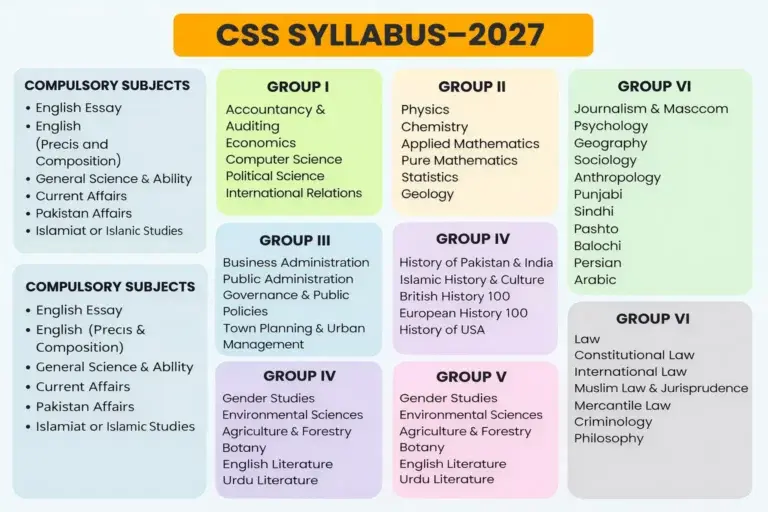
The full weightage of all five MPT subjects is covered in our CSS MPT syllabus 2027 breakdown.
Component 1: Basic Arithmetic, Algebra and Geometry
This is where the bulk of the section sits. Every topic below has appeared repeatedly in screening tests.
Topics tested:
- Percentage and percentage change
- Ratio and proportion
- Profit, loss and discount
- Averages
- Simple and compound interest
- Time and work
- Time, speed and distance
- Simple equations and basic algebra
- Area, volume and mensuration
- Number problems, LCM and HCF
- Data interpretation from tables and graphs
The Formula Sheet You Should Memorise
Print this and revise it daily. Formula recall under time pressure is worth more here than conceptual understanding.
| Concept | Formula |
| Percentage of a number | (Rate × Number) ÷ 100 |
| Profit percentage | (Profit ÷ Cost Price) × 100 |
| Loss percentage | (Loss ÷ Cost Price) × 100 |
| Selling price after discount | Marked Price − (Discount % × Marked Price) |
| Simple interest | (P × R × T) ÷ 100 |
| Compound amount | P × (1 + R/100)^T |
| Average | Sum of values ÷ Number of values |
| Speed | Distance ÷ Time |
| Combined work rate | 1/a + 1/b |
| Area of circle | πr² |
| Area of triangle | ½ × base × height |
| Relationship of LCM and HCF | LCM × HCF = Product of two numbers |
Solved Arithmetic MCQs
1. If 40% of a number is 96, the number is:
(a) 200 (b) 240 (c) 260 (d) 280
Answer: (b) 240. Divide 96 by 0.40. Whenever a percentage of an unknown is given, divide rather than multiply.
2. An item bought for Rs. 800 is sold for Rs. 920. The profit percentage is:
(a) 12% (b) 15% (c) 18% (d) 20%
Answer: (b) 15%. Profit is Rs. 120. Divide by cost price, not selling price — this is the single most common error in this topic.
3. Rs. 4,500 is divided between two people in the ratio 4:5. The larger share is:
(a) Rs. 2,000 (b) Rs. 2,250 (c) Rs. 2,500 (d) Rs. 2,700
Answer: (c) Rs. 2,500. Total parts are 9, so one part is Rs. 500. The larger share is five parts.
4. The average of five numbers is 27. If one number, 15, is removed, the average of the remaining four is:
(a) 28 (b) 29 (c) 30 (d) 32
Answer: (c) 30. Original total is 135. Remove 15 to get 120, then divide by four.
5. A completes a task in 12 days and B in 18 days. Working together they finish it in:
(a) 6 days (b) 7.2 days (c) 7.5 days (d) 8 days
Answer: (b) 7.2 days. Combined rate is 1/12 + 1/18 = 5/36, so the time is 36/5.
6. A train 150 metres long travelling at 72 km/h crosses a pole in:
(a) 6 seconds (b) 7.5 seconds (c) 8 seconds (d) 9 seconds
Answer: (b) 7.5 seconds. Convert 72 km/h to 20 m/s by multiplying by 5/18, then divide 150 by 20.
7. Simple interest on Rs. 5,000 at 8% per annum for 3 years is:
(a) Rs. 1,000 (b) Rs. 1,200 (c) Rs. 1,400 (d) Rs. 1,600
Answer: (b) Rs. 1,200. Apply (P × R × T) ÷ 100 directly.
8. Compound interest on Rs. 10,000 at 10% per annum for 2 years is:
(a) Rs. 2,000 (b) Rs. 2,100 (c) Rs. 2,200 (d) Rs. 2,400
Answer: (b) Rs. 2,100. The amount is 10,000 × 1.21 = 12,100. Subtract the principal. Note the Rs. 100 gap against simple interest — that gap is the concept being tested.
9. An article marked at Rs. 1,500 is sold at a 20% discount. The selling price is:
(a) Rs. 1,150 (b) Rs. 1,200 (c) Rs. 1,250 (d) Rs. 1,300
Answer: (b) Rs. 1,200.
10. The HCF of 24 and 36 is:
(a) 6 (b) 8 (c) 12 (d) 18
Answer: (c) 12.
11. If 3x + 7 = 25, then x equals:
(a) 4 (b) 5 (c) 6 (d) 7
Answer: (c) 6.
12. The area of a circle with radius 7 cm is:
(a) 144 cm² (b) 154 cm² (c) 164 cm² (d) 174 cm²
Answer: (b) 154 cm². Using π as 22/7 makes radius-7 questions instant. Examiners choose 7 and 14 deliberately.
Practise these topic by topic through our maths MCQs, with dedicated sets on percentage, ratio and proportion, profit and loss, averages and time and work problems.
Component 2: Logical Problem Solving and Analytical Abilities
Pattern-based and highly trainable. Twenty questions of practice noticeably changes your recognition speed.
Topics tested: number and letter series, coding and decoding, blood relations, direction sense, seating arrangements, syllogisms, statement and conclusion.
Solved Reasoning MCQs
13. Complete the series: 2, 6, 12, 20, 30, ?
(a) 40 (b) 42 (c) 44 (d) 46
Answer: (b) 42. The differences run 4, 6, 8, 10 — the next is 12.
14. Complete the series: 3, 9, 27, 81, ?
(a) 162 (b) 216 (c) 243 (d) 324
Answer: (c) 243. Each term is multiplied by 3.
15. Complete the letter series: A, C, F, J, O, ?
(a) S (b) T (c) U (d) V
Answer: (c) U. Positions increase by 2, 3, 4, 5, then 6. O is the 15th letter; 15 + 6 = 21, which is U.
16. If MANGO is coded as NBOHP, then APPLE is coded as:
(a) BQQMF (b) BQPMF (c) AQQMF (d) BRQMF
Answer: (a) BQQMF. Each letter moves forward by one position.
17. Pointing to a man, a woman said, “He is the son of my mother’s only son.” The man is the woman’s:
(a) Son (b) Brother (c) Nephew (d) Cousin
Answer: (c) Nephew. Her mother’s only son is her brother, so the man is her brother’s son.
18. A man walks 5 km north, turns right and walks 3 km, then turns right and walks 5 km. How far is he from the starting point?
(a) 3 km (b) 5 km (c) 8 km (d) 13 km
Answer: (a) 3 km. The two 5 km stretches cancel. Sketch these rather than visualising them — a five-second diagram prevents a wrong answer.
19. Statements: All roses are flowers. Some flowers fade quickly. Conclusion: Some roses fade quickly.
(a) Follows (b) Does not follow (c) Cannot be determined (d) Partially follows
Answer: (b) Does not follow. The flowers that fade quickly may be entirely outside the rose category. In syllogisms, evaluate only what the statements guarantee.
Build this component through our intelligence MCQs section.
Component 3: Mental Abilities
The smallest of the three components, but the questions are quick and should never be left blank.
Topics tested: analogies, odd one out, pattern recognition, non-verbal reasoning, figure series, mirror and water images.
20. Which is the odd one out: Rectangle, Square, Triangle, Circle?
(a) Rectangle (b) Square (c) Triangle (d) Circle
Answer: (d) Circle. It is the only figure without straight sides or vertices.
21. Which is the odd one out: 8, 27, 64, 100, 125?
(a) 27 (b) 64 (c) 100 (d) 125
Answer: (c) 100. All others are perfect cubes.
22. Doctor is to Hospital as Teacher is to:
(a) Student (b) Book (c) School (d) Education
Answer: (c) School. The relationship is professional-to-workplace. Identify the relationship type before scanning the options — this prevents the pull of an emotionally plausible but structurally wrong answer.
Work through our verbal and non-verbal reasoning MCQs for the full range of these sets.
Speed Techniques That Convert Knowledge Into Marks
Knowing the method is not enough at one minute per question across the full paper.
Back-solve from the options. In equations and number problems, substituting the options is frequently faster than solving forward. Start with the middle value to halve the remaining possibilities.
Approximate before calculating. If a percentage question yields roughly 240 and only one option is near that figure, you are done. Exact calculation is often unnecessary.
Use 22/7 recognition. Circle questions with a radius of 7, 14 or 21 are designed for instant computation.
Skip data interpretation on the first pass. These sets consume disproportionate time. Mark them and return once the quick questions are secured.
Never leave a blank. There is no negative marking in the MPT. A blank and a wrong answer both score zero, so an eliminated guess is always the better option. Our guide on solving MCQs faster and more accurately covers the full elimination framework.
A 10-Day General Abilities Practice Schedule
| Days | Focus | Target |
| 1–2 | Percentage, ratio and proportion | 50 questions per day |
| 3–4 | Profit, loss, discount, averages | 50 questions per day |
| 5 | Simple and compound interest | 40 questions |
| 6 | Time and work, speed and distance | 50 questions |
| 7 | Equations, area and mensuration | 40 questions |
| 8 | Number and letter series, coding-decoding | 50 questions |
| 9 | Blood relations, direction sense, syllogisms | 40 questions |
| 10 | Mixed timed set of 60 questions in 60 minutes | Diagnostic |
Maintain an error log throughout. Record every wrong answer once, review it twice, and retest only the entries you still cannot explain. We prioritise a strategy built on error correction rather than question volume alone — solving a fifth practice set without auditing the fourth produces repetition, not improvement.
For the full four-week schedule that sequences this section alongside the other four subjects before 27 September 2026, see our CSS MPT 2027 preparation guide. To practise under timed conditions, use our online quiz section.
Conclusion
General Abilities carries 60 marks and responds to practice faster than any other section in the CSS MPT. Memorise the formula sheet, then drill arithmetic topic by topic rather than reading theory. Reasoning improves through volume — series, coding-decoding and blood relations all become automatic within a week of consistent sets. Skip slow data interpretation on your first pass and return to it later. With no negative marking in the paper, every question deserves an answer.
Why Choose Us
We built MCQsDrive as a free practice platform for Pakistani competitive exam aspirants, organised by the exact subjects and weightings that commissions test.
- Topic-wise maths and reasoning sets mapped to the General Abilities syllabus
- Free practice with no registration barrier before you begin
- Timed quiz format that replicates real screening-test conditions
- Solved questions with working shown, not answer keys alone
- Guides covering CSS, PPSC, FPSC, NTS, KPPSC and SPSC in one place
Frequently Asked Questions
1. How many marks does General Abilities carry in the CSS MPT?
General Abilities carries 60 marks out of 200, making it 30% of the paper and the highest-weight section in the CSS MPT syllabus.
2. What topics come under CSS MPT general abilities MCQs?
Three components: basic arithmetic, algebra and geometry; logical problem solving including series, coding-decoding, blood relations and syllogisms; and mental abilities covering analogies, odd-one-out and non-verbal reasoning.
3. What is the difficulty level of the arithmetic section?
Secondary-school level. The challenge is calculation speed under an average of one minute per question, not conceptual complexity.
4. Is a calculator allowed in the CSS MPT?
No. Calculators and all electronic devices are prohibited in the examination hall, which is why mental calculation speed matters as much as method.
5. How much time should I give this section during preparation?
Given that it carries 30% of the paper and improves quickly with practice, we recommend allocating roughly a third of your total MPT preparation hours to General Abilities.