Intelligence MCQs with Answers for FIA & Police Test
Most candidates in Pakistan spend months on General Knowledge and Current Affairs, then lose easy marks in the intelligence section. That section is not about memory at all. It rewards pattern recognition and speed.
We have seen this happen in FIA, Police, Excise and PPSC papers year after year. Candidates who practise intelligence MCQs daily finish this portion in half the time and use those saved minutes on tougher subjects.
Which Exams Include an Intelligence Section
The intelligence portion appears in almost every recruitment test conducted for law-enforcement and clerical posts in Pakistan. The number of questions changes with the post and the testing body, but the question types stay the same.
| Exam / Post | Typical Intelligence Weightage | Common Question Types |
| FIA (ASI, Constable, UDC/LDC) | Around 15–20 questions | Series, analogies, coding, directions |
| Punjab Police / KP Police (ASI, Constable) | Around 10–20 questions | Non-verbal figures, series, blood relations |
| Excise & Taxation Constable | Around 10–15 questions | Odd one out, ranking, simple logic |
| PPSC Junior Clerk / Assistant | Around 10–15 questions | Analogies, coding-decoding, number series |
| Pak Army (Initial Tests) | Verbal + non-verbal both tested | Figure patterns, mirror images, series |
Always confirm the exact split from the official advertisement, because the same department can change its paper pattern between two hiring cycles. Our FIA test syllabus with subject-wise marks distribution breaks down one such pattern in detail.
The good news is simple: the syllabus for this section never really changes. Once you master six or seven question families, you can attempt any commission’s paper. Let us start with the verbal side.
Verbal Reasoning: Analogies, Odd One Out, Coding-Decoding
Verbal reasoning uses words, letters and relationships instead of figures. It carries the largest share of the intelligence portion in FIA and clerical papers.
Analogies
An analogy asks you to find the same relationship between a second pair of words.
Three-step method:
- Say the relationship of the first pair out loud in one short sentence.
- Apply that exact sentence to the options.
- Reject any option where the relationship changes direction.
Q1. Doctor : Patient :: Teacher : ?
(a) School (b) Student (c) Book (d) Salary
Answer: (b) Student — A doctor treats a patient; a teacher teaches a student. Both are service-provider to receiver.
Q2. Pen : Write :: Knife : ?
(a) Sharp (b) Kitchen (c) Cut (d) Steel
Answer: (c) Cut — Tool to its function. “Sharp” is a quality, not a function.
Q3. Hand : Glove :: Foot : ?
(a) Shoe (b) Leg (c) Walk (d) Toe
Answer: (a) Shoe — Body part to the item worn on it.
For deeper practice on word pairs, our related pair of words MCQs section follows the same logic used in commission papers.
Odd One Out
Here, four items share one property and one does not.
Q4. Copper, Silver, Iron, Wood
Answer: Wood — The other three are metals.
Q5. 3, 5, 7, 9, 11
Answer: 9 — All others are prime numbers.
We always advise candidates to check two properties before choosing: category first, then number property. Many candidates pick the wrong option because they stop at the first pattern they notice.
Coding-Decoding
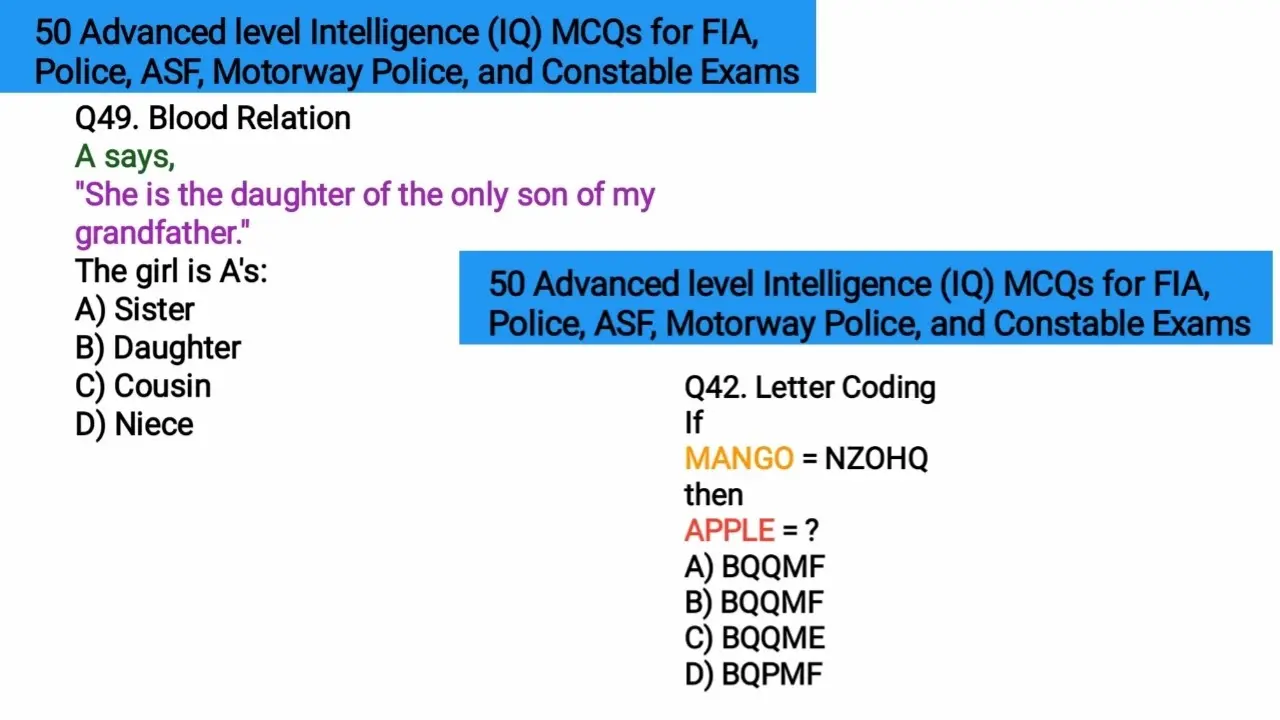
Coding questions replace letters with other letters or numbers using a fixed rule.
Q6. If CAT is written as DBU, then DOG is written as?
Answer: EPH — Every letter moves one step forward in the alphabet.
Q7. If RED is coded as DER, then BLUE is coded as?
Answer: EULB — The word is simply reversed.
Three-step method: write the alphabet positions, check the gap between original and coded letters, then apply the same gap to the new word. Never guess before you confirm the rule on at least two letters.
Once letter movement makes sense to you, number and letter series become far easier, because they use the same idea of a fixed step.
Number and Letter Series — Step-by-Step Method
Series questions are the fastest scoring items in the paper once you learn to read differences instead of numbers.
Our method:
- Write the difference between each pair of terms.
- If differences are equal, the rule is addition. If they grow, check second-level differences.
- If numbers grow very fast, test multiplication or squares.
Q8. 2, 6, 12, 20, 30, ?
Answer: 42 — Differences are 4, 6, 8, 10, so the next difference is 12.
Q9. 3, 9, 27, 81, ?
Answer: 243 — Each term is multiplied by 3.
Q10. 5, 11, 23, 47, ?
Answer: 95 — Each term is doubled and 1 is added.
Q11. 1, 4, 9, 16, ?
Answer: 25 — Squares of 1, 2, 3, 4, 5.
Letter series work the same way, but you count alphabet positions.
Q12. A, C, E, G, ?
Answer: I — Skip one letter each time.
Q13. AZ, BY, CX, ?
Answer: DW — The first letter moves forward, the second moves backward.
If number patterns feel weak, work through our odd man out and series MCQs in the maths section first. Strong number sense here also helps in the arithmetic portion of the same paper.
Non-Verbal Reasoning: Figure Patterns, Mirror and Water Images
Non-verbal questions use shapes instead of words. Police and Army tests rely on them heavily because they test observation under pressure.
The four types you must know:
- Figure series — Shapes rotate, add elements or shift position in a fixed order.
- Mirror images — Left and right sides swap, as if a mirror is placed beside the figure.
- Water images — Top and bottom swap, as if the figure is reflected in water below it.
- Embedded figures — A small shape is hidden inside a bigger design.
Q14. What is the mirror image of the letter “b”?
Answer: “d” — Left and right reverse, the height stays the same.
Q15. What is the water image of the letter “b”?
Answer: “p” — Top and bottom reverse.
Q16. In a figure series, a triangle rotates 90 degrees clockwise in every step. If it points up now, where will it point after two steps?
Answer: Downward — 90 degrees twice equals 180 degrees.
A practical tip from our own paper analysis: for mirror images, cover the option list and predict the answer yourself first. Options are designed to look almost identical, and reading them early confuses the eye.
We keep both formats together in our verbal and non-verbal reasoning MCQs so you can switch between them exactly like the real paper does.
More Solved Intelligence MCQs with Reasoning
Q17. In a row of 40 students, Ali is 12th from the left. What is his position from the right?
Answer: 29th — 40 − 12 + 1 = 29.
Q18. Pointing to a photograph, a man said, “He is the son of my father’s only son.” Who is in the photograph?
Answer: His own son — Father’s only son is the man himself.
Q19. A man walks 5 km north, turns right and walks 3 km, then turns right again and walks 5 km. Where is he now?
Answer: 3 km east of the starting point, facing south.
Q20. If in a certain code 1 = A, 2 = B, 3 = C, what does 3-1-2 stand for?
Answer: CAB.
Q21. Complete the series: Z, X, V, T, ?
Answer: R — Every alternate letter moving backwards.
You will find hundreds more of these, arranged topic by topic, in our intelligence MCQs practice section. Solving them in timed sets is what converts understanding into marks.
Time-Saving Techniques for the Intelligence Portion
Speed is the real test here. Most candidates know the method but run out of minutes.
What works in the exam hall:
- Give each question a 30-second limit. If the pattern does not appear, mark it and move on.
- Attempt series and analogies first — they are the fastest and most predictable.
- Use elimination before calculation; two options are usually clearly wrong.
- Check whether negative marking applies before guessing blindly.
- Return to skipped questions only after completing the full paper once.
We prioritise a strategy of daily timed practice over long study hours. Twenty questions a day for four weeks will do more for your score than one long session every weekend. If you are preparing for a specific department, follow this with our step-by-step FIA test preparation guide to plan the remaining subjects around it.
Conclusion
The intelligence section is the easiest place to gain marks in FIA, Police and PPSC tests. It needs pattern practice, not memorisation. Learn the six core question types, practise them under a clock, and protect the minutes you save for tougher subjects. Consistency here directly improves your final merit position.
Why Choose MCQsDrive
We build every practice set around real paper patterns used by Pakistani commissions and testing agencies, not random question dumps.
- Topic-wise intelligence MCQs with clear reasoning behind every answer
- Free quiz mode with timers that match actual test conditions
- Content aligned with FIA, Police, Excise, PPSC and Army test formats
- Regular updates as departments revise their paper patterns
- 20+ subjects on one platform, so you prepare the full paper in one place
FAQs
1. Is the intelligence test difficult in FIA?
No. The questions are basic in level, but the time limit makes them feel hard. Regular practice removes that pressure.
2. How many intelligence questions come in the Police test?
Usually between 10 and 20, depending on the post and province. Confirm from the official advertisement for your cycle.
3. What is the difference between verbal and non-verbal reasoning?
Verbal reasoning uses words, letters and numbers. Non-verbal reasoning uses shapes, figures and images.
4. Can I prepare for the intelligence section in one month?
Yes. One month of daily timed practice is enough for most candidates, provided you cover all question types.
5. Do intelligence questions repeat in past papers?
The exact questions rarely repeat, but the patterns do. That is why practising by question type works better than memorising past papers.